第八章 拉普拉斯变换
重点:Laplace 变换的性质与应用、逆变换的留数计算法
难点:周期函数和 \(\delta\) 函数的变换、留数法求逆变换
7.0 动机:从 Fourier 到 Laplace(单边变换)
Fourier 变换在理论与工程中非常重要,但通常要求 \(f(t)\) 在 \((-\infty,+\infty)\) 上绝对可积。很多常见函数(常数、多项式、正弦余弦等)不满足该条件;并且许多工程信号只关心 \(t\ge 0\) 的响应(初值问题、因果系统),对 \(t<0\) 的取值要么没有定义、要么没有意义。
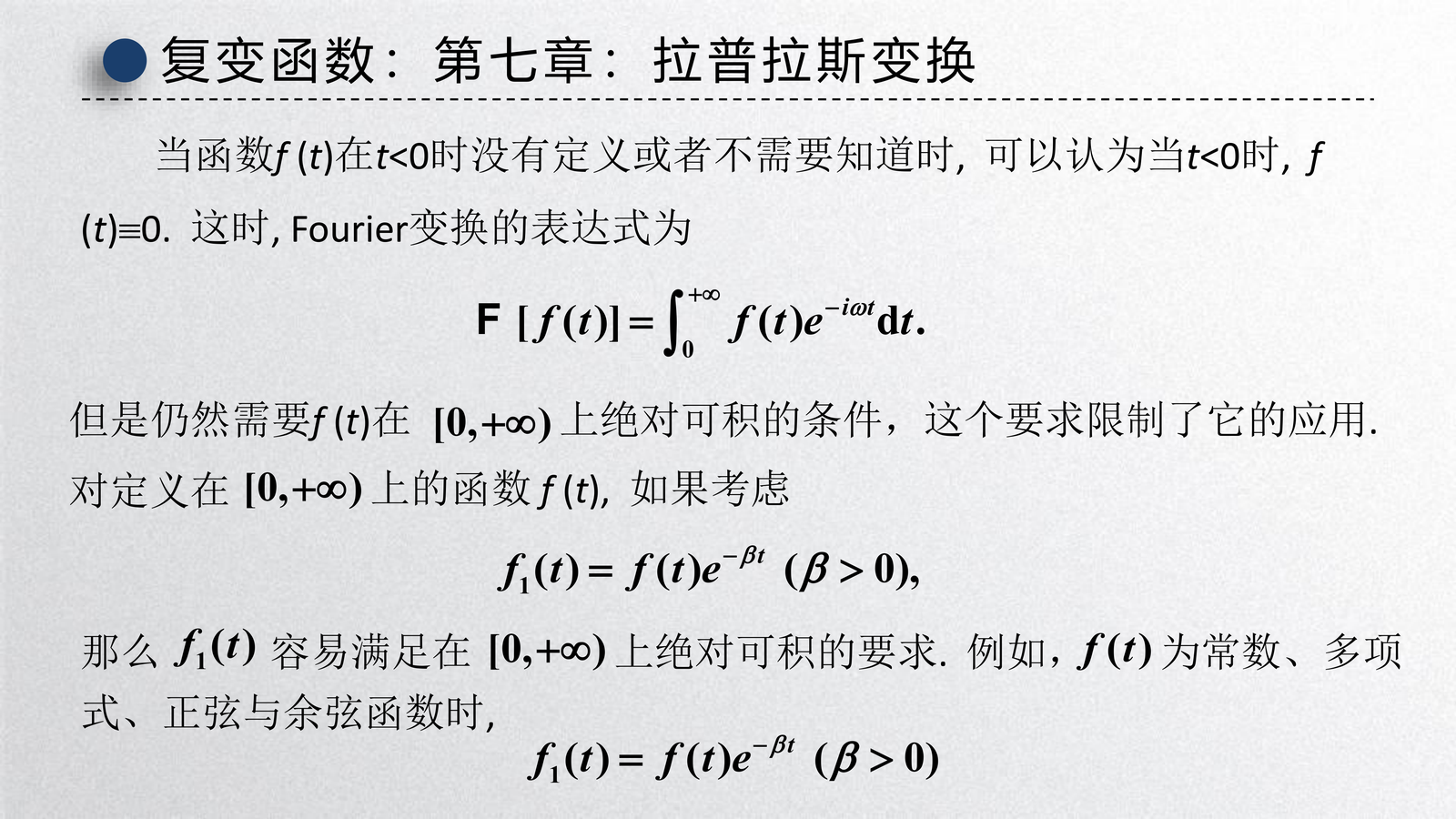
讲义的核心思路是:对 \(t\ge 0\) 的函数 \(f(t)\),引入一个指数衰减因子 \(e^{-\beta t}\)(\(\beta>0\))把增长“压住”,使其更容易绝对可积。于是类似 Fourier 变换的积分变为
记 \(s=\beta+i\omega\),就得到 Laplace 变换的标准形式:
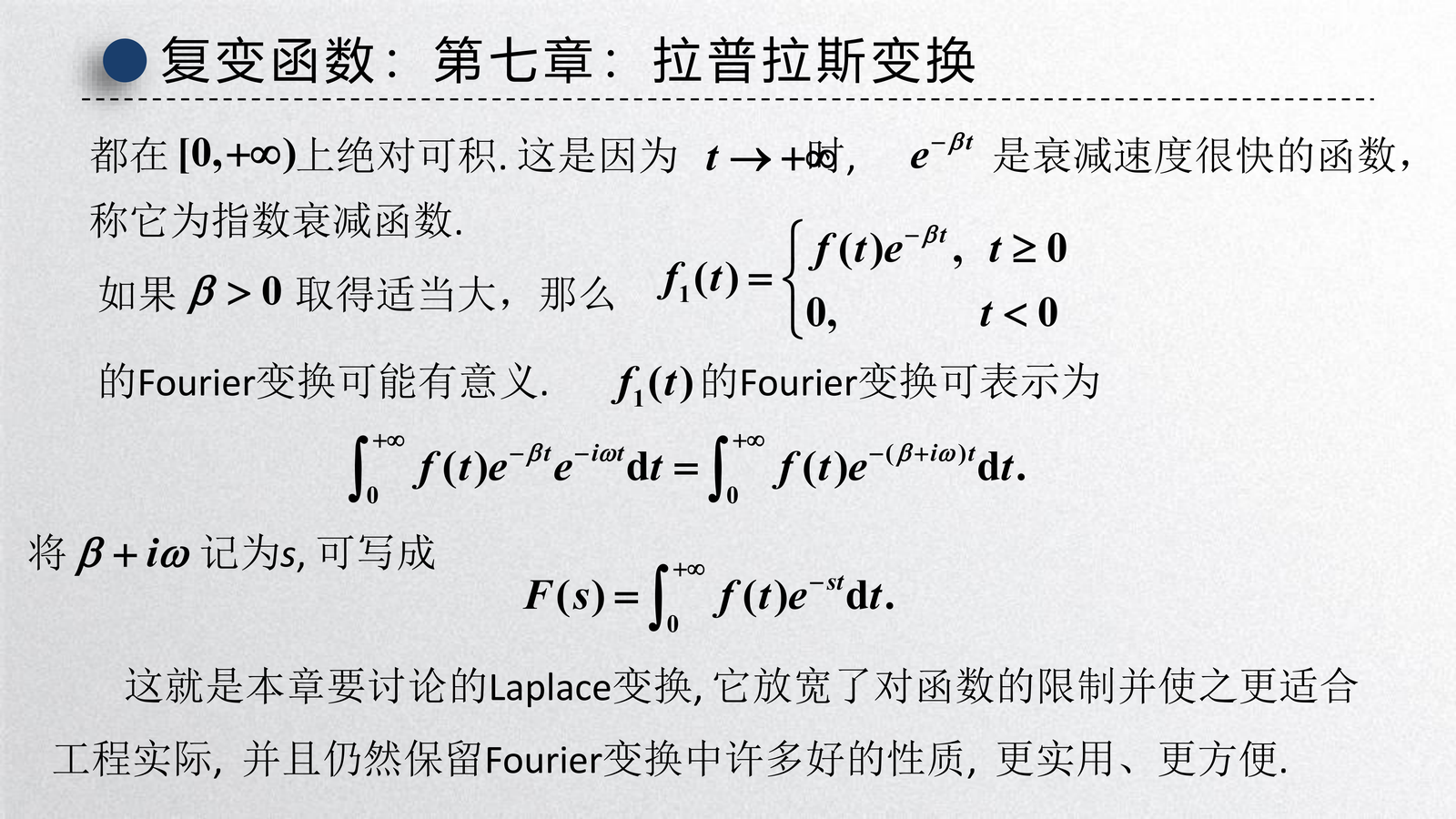
这解释了两个关键点:
- Laplace 变换本质上是在 Fourier 框架里把频率轴“推”到复平面 \(s=\sigma+i\omega\) 上,从而显著放宽可积性要求。
- 工程里常用的是 单边(unilateral)Laplace:把 \(t<0\) 视为 \(0\),尤其适合初值问题与因果系统。
7.1 Laplace 变换的概念
定义与存在定理
定义 1(Laplace 变换)
设函数 \(f(t)\) 在 \(t \geq 0\) 上有定义,且积分
在复参数 \(s\) 的某一区域内收敛,则称 \(F(s)\) 为 \(f(t)\) 的 Laplace 变换(像函数),\(f(t)\) 为 \(F(s)\) 的 像原函数。
单边(unilateral)与双边(bilateral)Laplace
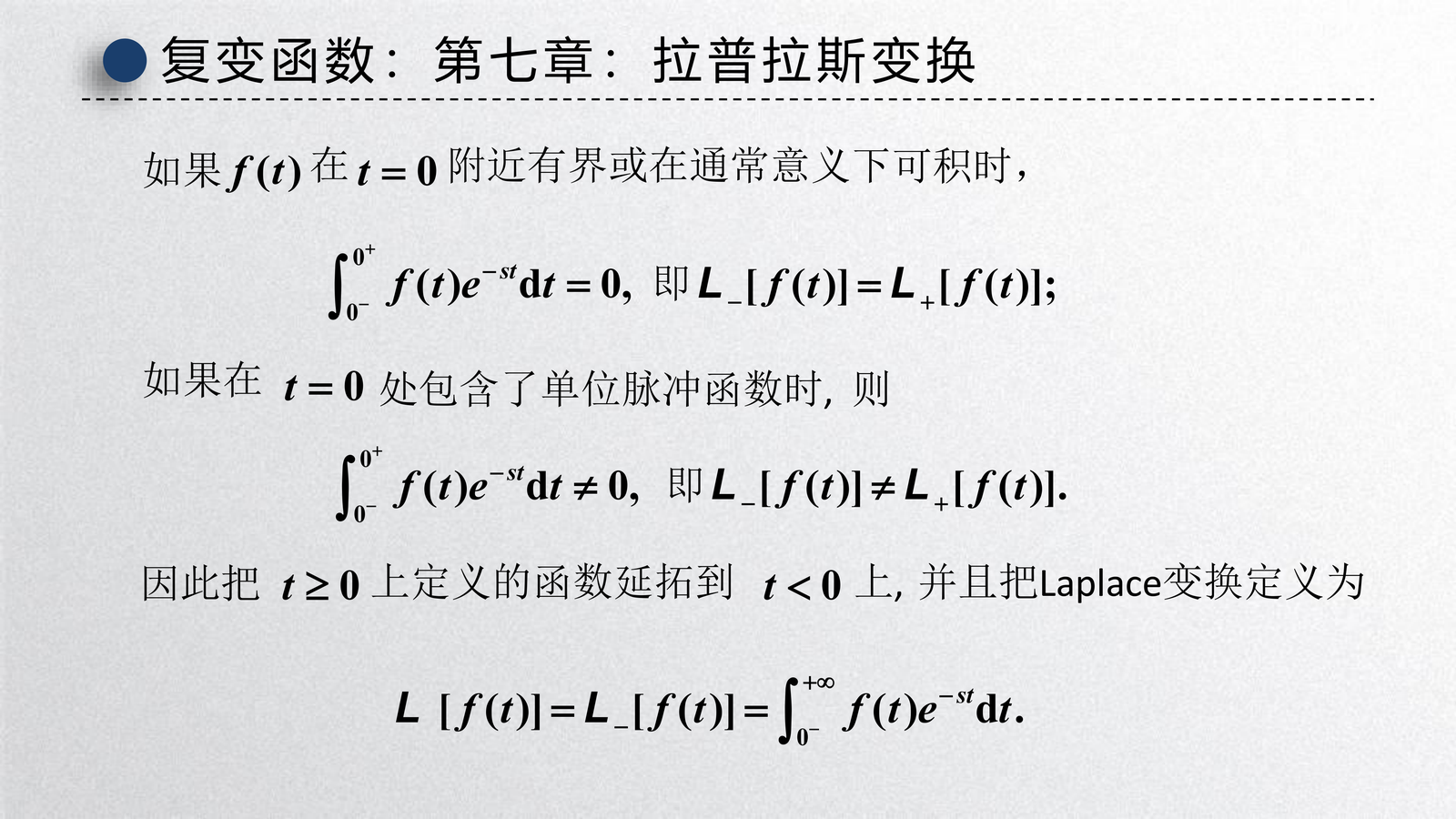
本章默认采用单边 Laplace:只积分 \(t\ge 0\) 的部分,因此非常适合处理初值问题。若 \(f(t)\) 在 \(t=0\) 附近可积且无冲激项,通常可以把 \(t<0\) 处延拓为 \(0\) 而不影响变换结果;但若 \(t=0\) 处含有 \(\delta(t)\) 等冲激项,则需要特别注意 \(t=0\) 的贡献。
定理 1(Laplace 变换存在定理)
若函数 \(f(t)\) 满足:
- 在 \(t \geq 0\) 的任一有限区间上 分段连续
- 当 \(t \to +\infty\) 时,\(f(t)\) 的 增长指数 不超过某一指数函数,即存在常数 \(M > 0\),\(\sigma_0 \geq 0\),使得
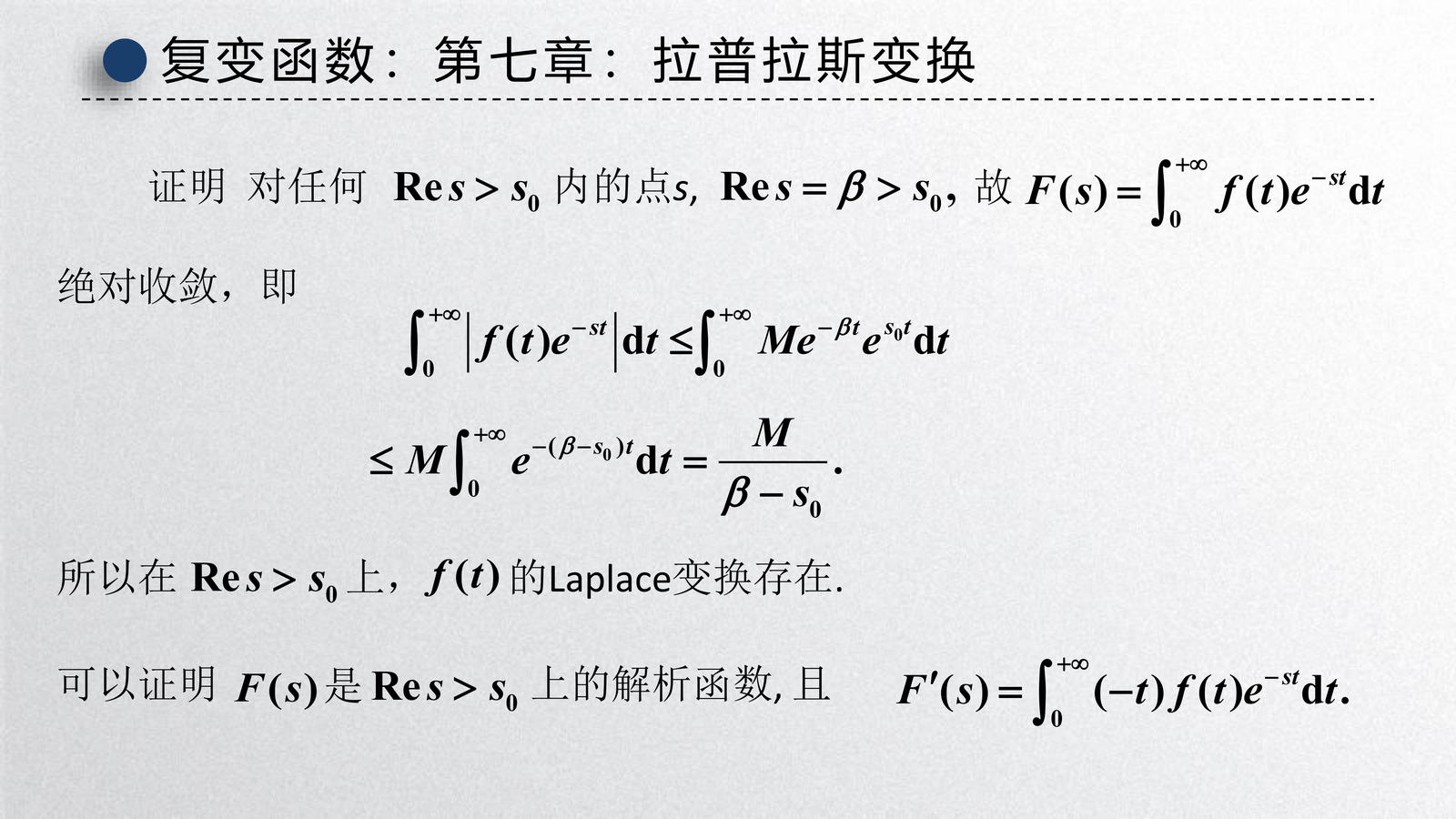
则 \(f(t)\) 的 Laplace 变换在 半平面 \(\text{Re}(s) > \sigma_0\) 上 存在且解析。
其中 \(\sigma_0\) 称为 \(f(t)\) 的 增长指数。
定理 1.1(Abel 型收敛定理与收敛半平面)
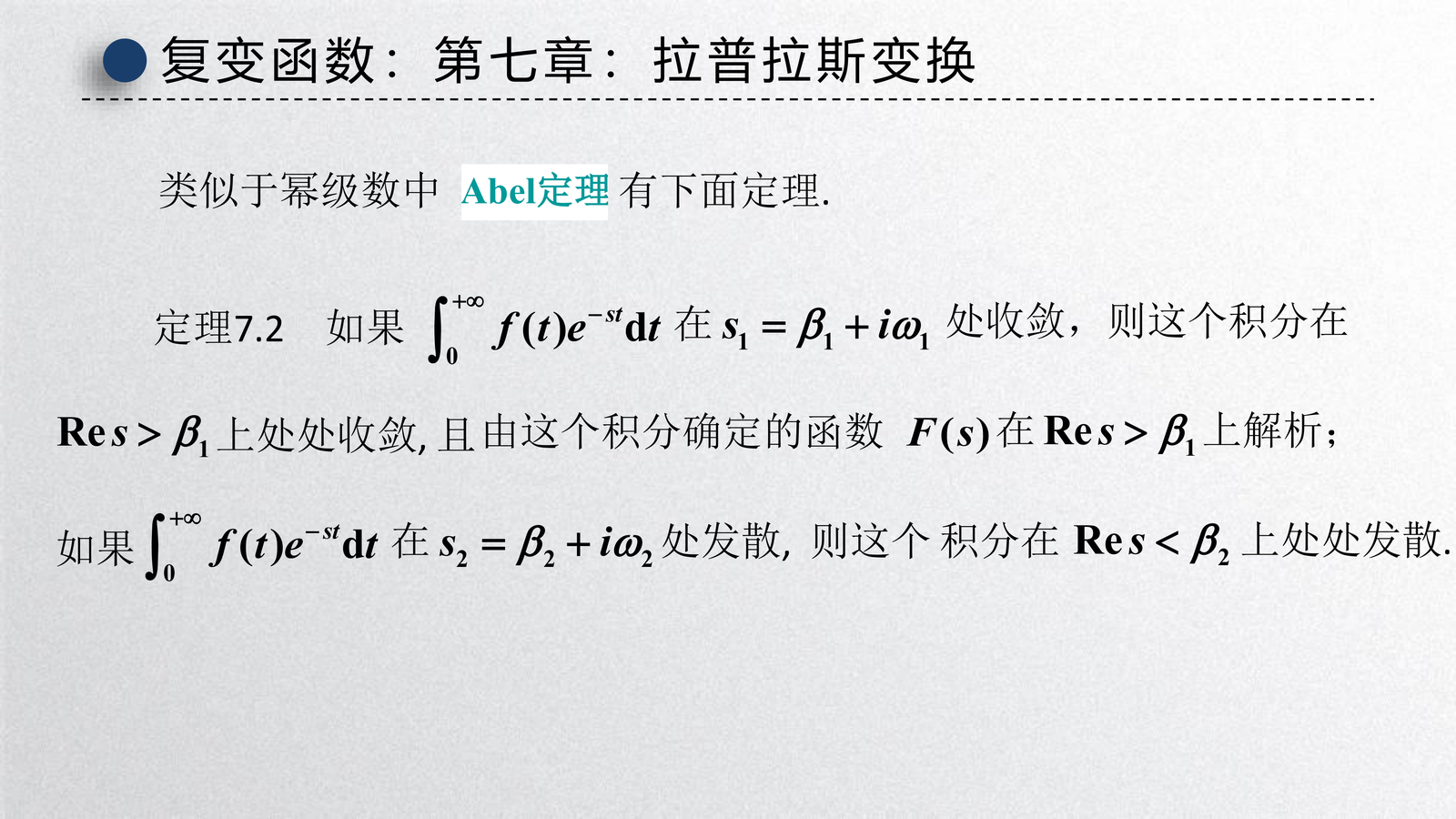
若积分 \(\int_0^{+\infty} f(t)e^{-st}\,\mathrm{d}t\) 在 \(s_1=\beta_1+i\omega_1\) 处收敛,则它在半平面 \(\text{Re}(s)>\beta_1\) 上处处收敛,且由该积分确定的像函数 \(F(s)\) 在该半平面上解析;若它在 \(s_2=\beta_2+i\omega_2\) 处发散,则它在 \(\text{Re}(s)<\beta_2\) 上处处发散。
收敛域(ROC)与收敛指数 \(\sigma\)
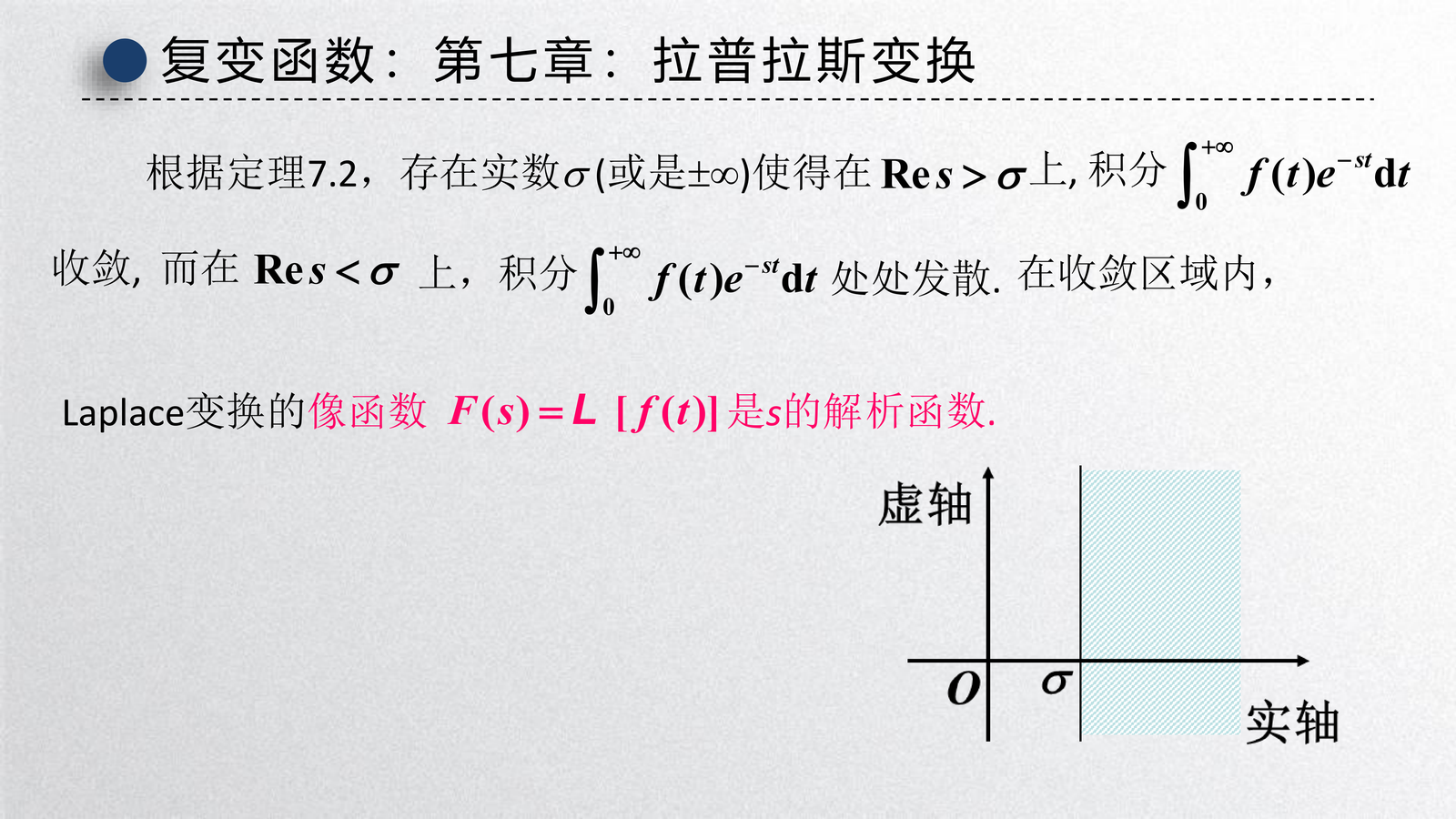
由上一结论可知:存在一个实数 \(\sigma\)(可能为 \(\pm\infty\)),使得
- 当 \(\text{Re}(s)>\sigma\) 时,\(\int_0^{+\infty} f(t)e^{-st}\,\mathrm{d}t\) 收敛
- 当 \(\text{Re}(s)<\sigma\) 时,该积分发散
且在收敛域内像函数 \(F(s)=\mathcal{L}[f(t)]\) 是 \(s\) 的解析函数。
基本变换对
例 1:单位阶跃函数 \(u(t)\)
例 2:指数函数 \(e^{at}\)
例 3:正弦函数 \(\sin\omega t\) 和余弦函数 \(\cos\omega t\)
利用 \(\sin\omega t = \frac{e^{i\omega t} - e^{-i\omega t}}{2i}\):
同理:
例 4:幂函数 \(t^n\)(\(n\) 为正整数)
利用分部积分:
特别地,\(\mathcal{L}[1] = \frac{1}{s}\),\(\mathcal{L}[t] = \frac{1}{s^2}\)。
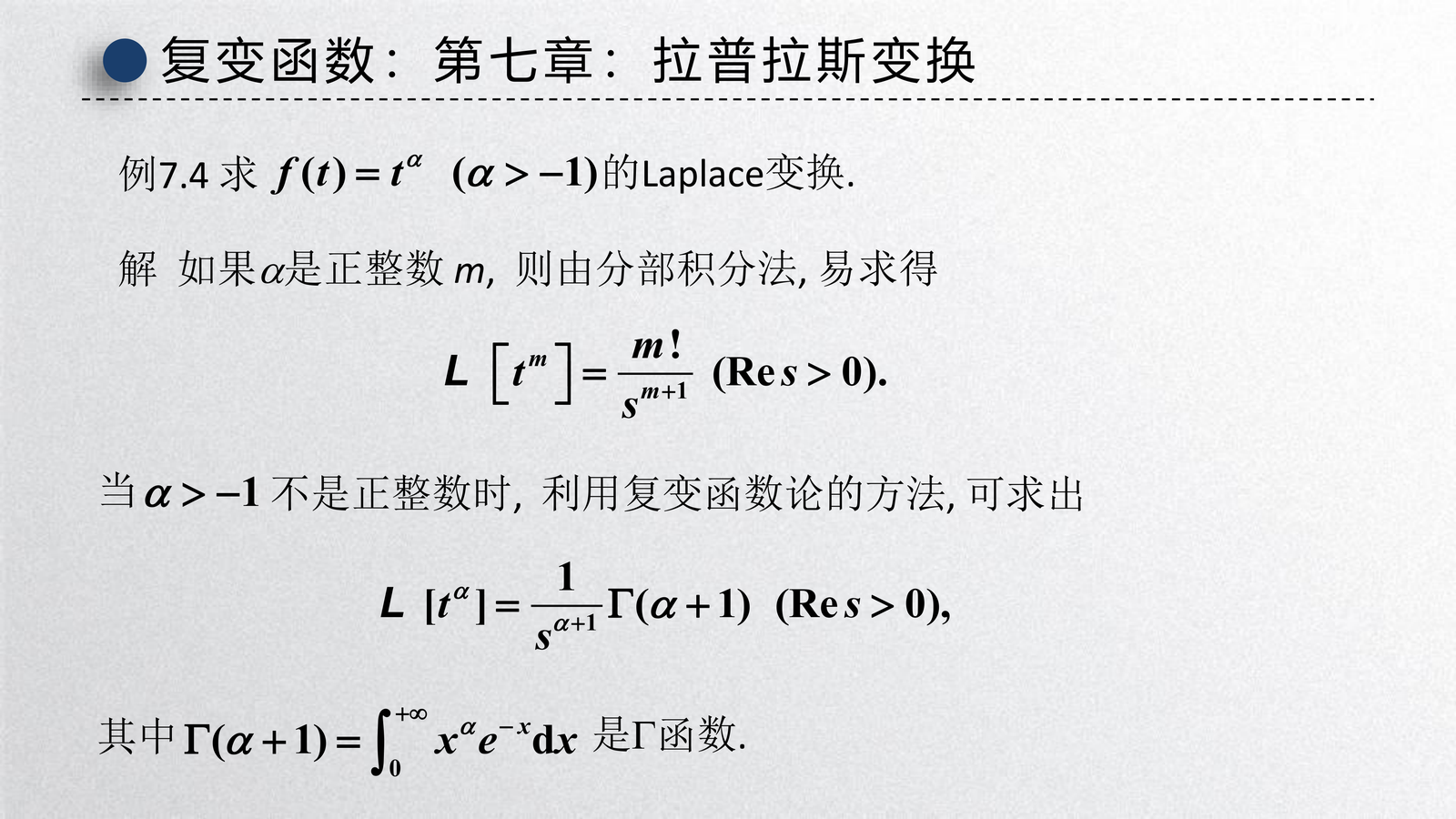
对于一般幂函数 \(t^\alpha\)(\(\alpha > -1\)):
其中 \(\Gamma(s)\) 为 Gamma 函数。
常用 Laplace 变换对表
| \(f(t)\) | \(F(s) = \mathcal{L}[f(t)]\) | 收敛域 |
|---|---|---|
| \(1\) | \(\frac{1}{s}\) | \(\text{Re}(s) > 0\) |
| \(t^n\)(\(n = 0, 1, 2, \ldots\)) | \(\frac{n!}{s^{n+1}}\) | \(\text{Re}(s) > 0\) |
| \(e^{at}\) | \(\frac{1}{s-a}\) | \(\text{Re}(s) > \text{Re}(a)\) |
| \(\sin\omega t\) | \(\frac{\omega}{s^2 + \omega^2}\) | \(\text{Re}(s) > 0\) |
| \(\cos\omega t\) | \(\frac{s}{s^2 + \omega^2}\) | \(\text{Re}(s) > 0\) |
| \(\sinh\omega t\) | \(\frac{\omega}{s^2 - \omega^2}\) | $\text{Re}(s) > |
| \(\cosh\omega t\) | \(\frac{s}{s^2 - \omega^2}\) | $\text{Re}(s) > |
| \(t\sin\omega t\) | \(\frac{2\omega s}{(s^2 + \omega^2)^2}\) | \(\text{Re}(s) > 0\) |
| \(t\cos\omega t\) | \(\frac{s^2 - \omega^2}{(s^2 + \omega^2)^2}\) | \(\text{Re}(s) > 0\) |
| \(e^{at}\sin\omega t\) | \(\frac{\omega}{(s-a)^2 + \omega^2}\) | \(\text{Re}(s) > \text{Re}(a)\) |
| \(e^{at}\cos\omega t\) | \(\frac{s-a}{(s-a)^2 + \omega^2}\) | \(\text{Re}(s) > \text{Re}(a)\) |
周期函数和 \(\delta\) 函数的 Laplace 变换
周期函数的变换
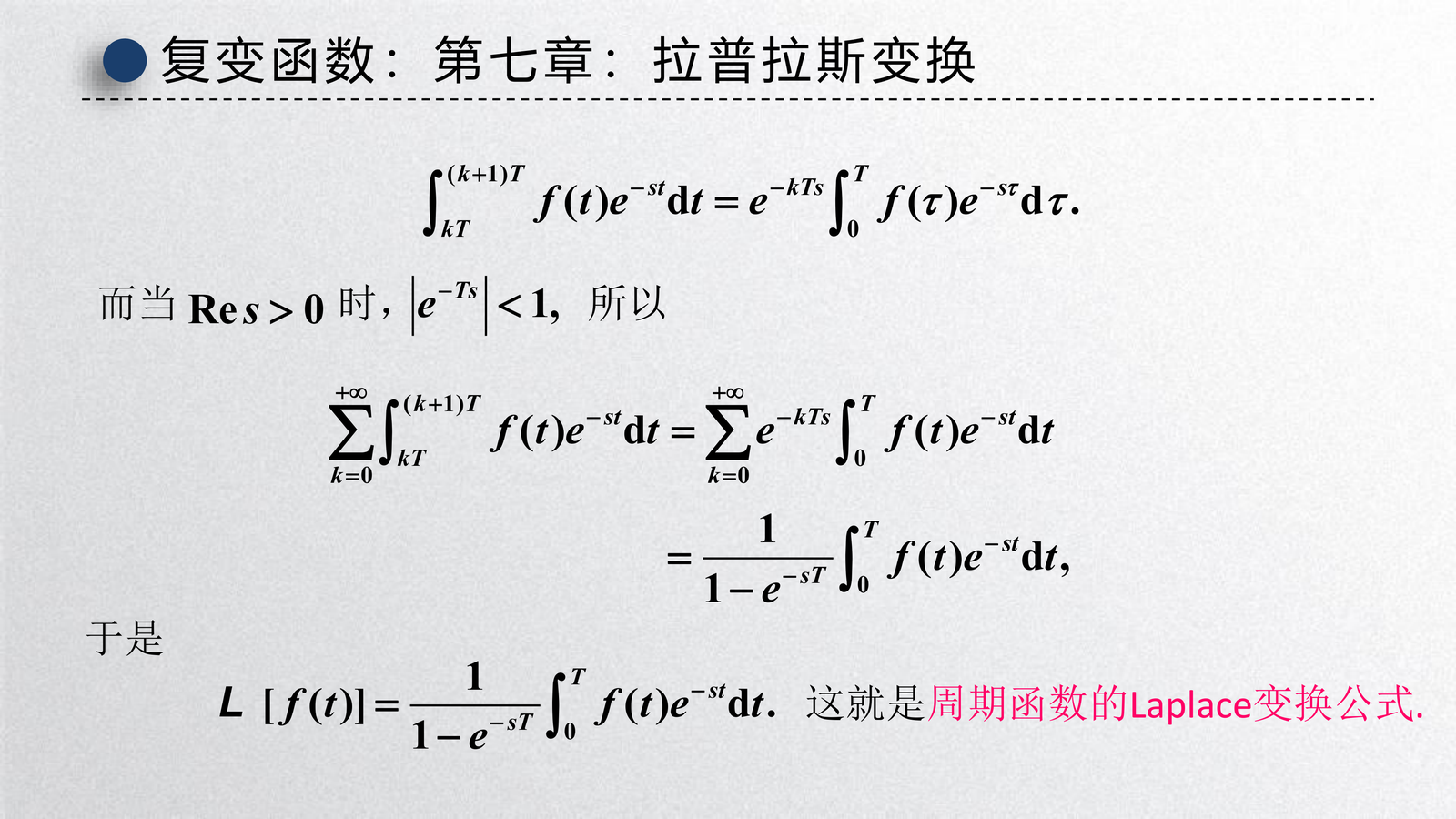
定理 2(周期函数的 Laplace 变换)
设 \(f(t)\) 是以 \(T\) 为周期的函数,则
例 5:全波整流函数 \(f(t) = |\sin t|\)
周期 \(T = \pi\),在 \([0, \pi]\) 上 \(f(t) = \sin t\):
单位脉冲函数 \(\delta(t)\)
定义 2(单位脉冲函数/Dirac delta 函数)
单位脉冲函数 \(\delta(t)\) 定义为:
筛选性质:\(\int_{-\infty}^{+\infty} f(t)\delta(t-t_0) \, \mathrm{d}t = f(t_0)\)
例 6:\(\delta(t)\) 的 Laplace 变换
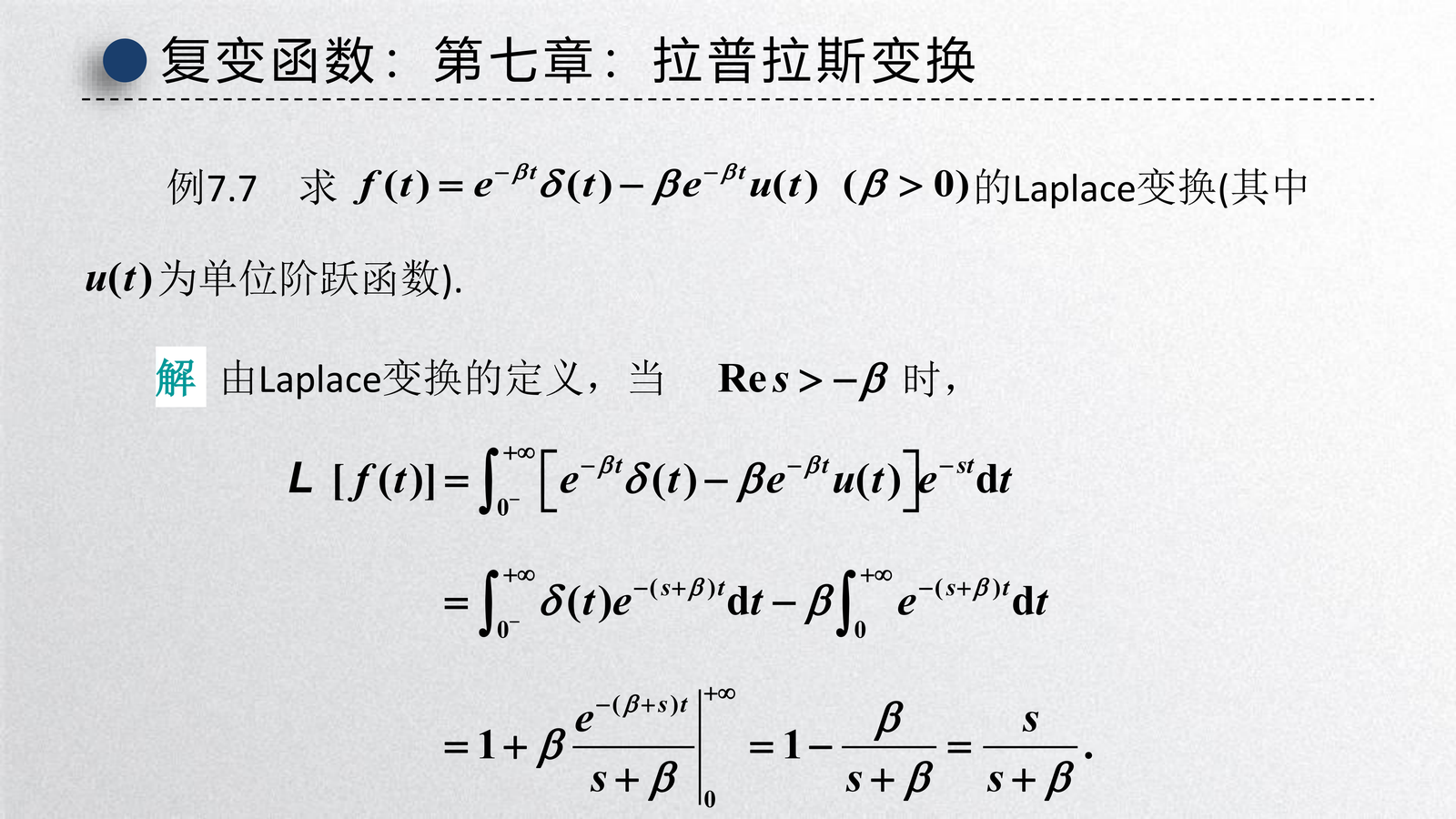
例 7:含延迟脉冲函数的变换
关于 \(\delta(t)\) 的几个常用记忆点
记住下面三点:
- \(\delta(t)\) 是广义函数(分布),它用“筛选性质”刻画:\(\int f(t)\delta(t-t_0)\,\mathrm{d}t=f(t_0)\)。
- 与单位阶跃函数的关系:在分布意义下 \(u'(t)=\delta(t)\),因此在处理含跳变输入的微分方程时,\(\delta\) 往往表示“瞬时冲击”。
- 单边 Laplace 中,若 \(t=0\) 处包含冲激项,需注意 \(t=0\) 附近的积分贡献(讲义有专门说明)。
7.2 Laplace 变换的性质
十大基本性质
1. 线性性质
性质 1(线性): $$ \mathcal{L}[\alpha f_1(t) + \beta f_2(t)] = \alpha F_1(s) + \beta F_2(s) $$
2. 微分性质
性质 2(微分): $$ \mathcal{L}[f'(t)] = sF(s) - f(0) $$
一般地:
例 8:用微分性质求 \(\mathcal{L}[\cos\omega t]\)
因 \((\sin\omega t)' = \omega\cos\omega t\),故
3. 像函数的微分性质
性质 3(像函数的微分): $$ F'(s) = -\mathcal{L}[tf(t)] \quad \text{即} \quad \mathcal{L}[tf(t)] = -F'(s) $$
一般地:\(\mathcal{L}[t^nf(t)] = (-1)^n F^{(n)}(s)\)。
例 10:求 \(\mathcal{L}[t\sin\omega t]\)
已知 \(\mathcal{L}[\sin\omega t] = \frac{\omega}{s^2+\omega^2}\)
4. 积分性质
性质 4(积分): $$ \mathcal{L}\left[\int_0^t f(\tau) \, \mathrm{d}\tau\right] = \frac{F(s)}{s} $$
5. 像函数的积分性质
性质 5(像函数的积分):若 \(\lim_{t \to 0^+} \frac{f(t)}{t}\) 存在,则
例 13:求 \(\mathcal{L}\left[\frac{\sin t}{t}\right]\) 及 \(\int_0^{+\infty} \frac{\sin t}{t} \, \mathrm{d}t\)
令 \(s = 0\):
6. 位移性质
性质 6(位移): $$ \mathcal{L}[e^{at}f(t)] = F(s - a) $$
例 11:求 \(\mathcal{L}[e^{at}\sin\omega t]\)
7. 延迟性质
性质 7(延迟):设 \(f(t) = 0\)(\(t < 0\)),则 \(\mathcal{L}[f(t - \tau)] = e^{-s\tau}F(s)\)(\(\tau > 0\))。
8. 相似性质
性质 8(相似): $$ \mathcal{L}[f(at)] = \frac{1}{a}F\left(\frac{s}{a}\right), \quad a > 0 $$
9. 初值和终值定理
性质 9(初值和终值定理):
- 初值定理:\(f(0^+) = \lim_{t \to 0^+} f(t) = \lim_{s \to \infty} sF(s)\)
- 终值定理(若 \(\lim_{t \to +\infty} f(t)\) 存在):\(\displaystyle\lim_{t \to +\infty} f(t) = \lim_{s \to 0} sF(s)\)
10. 卷积定理
定义 3(卷积):函数 \(f_1(t)\) 和 \(f_2(t)\) 的 卷积 定义为
性质 10(卷积定理):
卷积定理证明
令 \(\tau' = t - \tau\),交换积分次序:
7.3 Laplace 逆变换
反演积分公式
定理 3(反演积分公式)
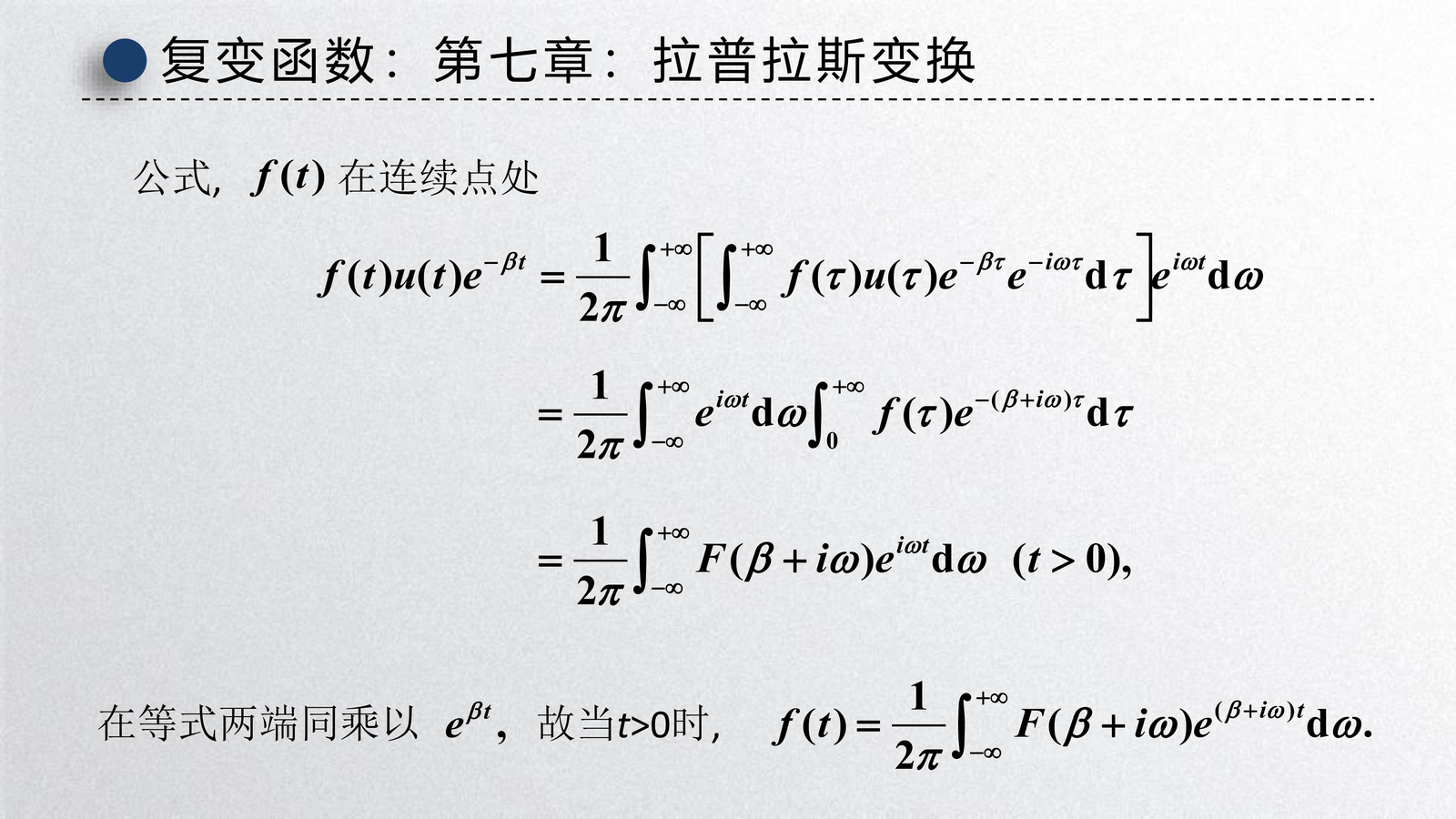
若 \(F(s)\) 是 \(f(t)\) 的 Laplace 变换,则
其中积分路径为复平面上直线 \(s = \beta\)(\(\beta > \sigma_0\),\(\sigma_0\) 为 \(f(t)\) 的增长指数),方向自下而上。
\(\beta\) 取在奇点右侧是什么意思
反演积分路径 \(s=\beta\) 通常要求落在 \(F(s)\) 的收敛域内(ROC),并且位于 \(F(s)\) 的所有孤立奇点右侧。这样在用围道闭合并应用留数时,可以把所有需要贡献的奇点都包进闭合曲线内部。
留数法求逆变换
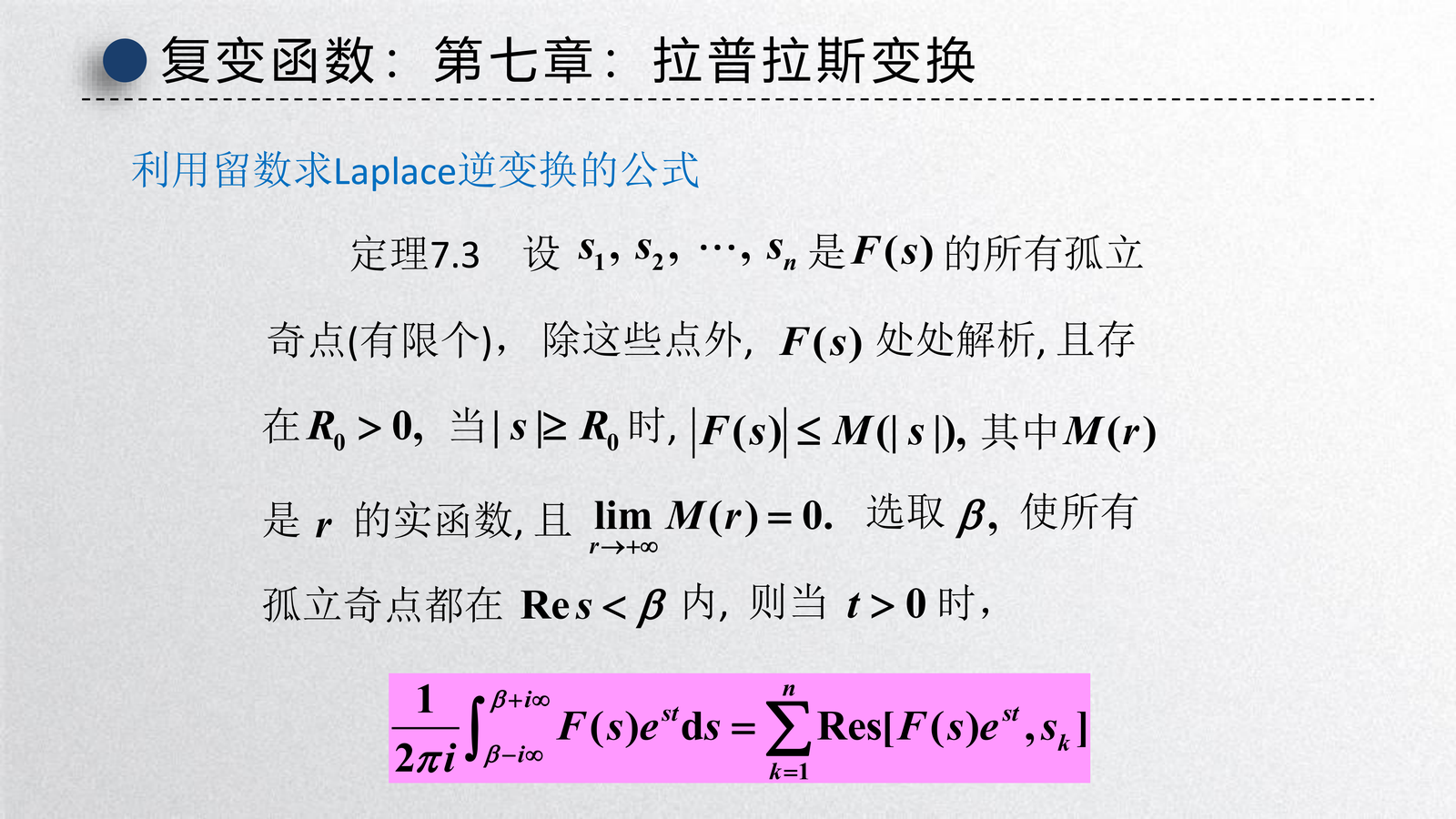
定理 4(留数法)
若 \(F(s)\) 在复平面上除有限个孤立奇点 \(s_1, s_2, \ldots, s_n\) 外解析,且当 \(s \to \infty\) 时 \(F(s) \to 0\),则
即 \(f(t)\) 等于 \(F(s)e^{st}\) 在其所有奇点处留数之和。
例 21:求 \(\mathcal{L}^{-1}\left[\frac{1}{s^2+1}\right]\)
\(F(s)e^{st} = \frac{e^{st}}{s^2+1} = \frac{e^{st}}{(s-i)(s+i)}\) 有奇点 \(s = \pm i\)
在 \(s = i\):
在 \(s = -i\):
因此
例 22:求 \(\mathcal{L}^{-1}\left[\frac{1}{s(s-1)^2}\right]\)
\(F(s)e^{st}\) 有奇点 \(s = 0\)(一级)和 \(s = 1\)(二级)
在 \(s = 0\):
在 \(s = 1\):
因此
7.4 Laplace 变换的应用
求解微分方程
基本思路: 1. 对方程两边进行 Laplace 变换 2. 得出像函数的代数方程 3. 求出像函数 4. 通过逆变换得出解
例 26:求解二阶常系数线性微分方程初值问题
解:设 \(\mathcal{L}[x(t)] = X(s)\),对方程两边取 Laplace 变换:
(利用 \(\mathcal{L}[e^t\cos t] = \frac{s-1}{(s-1)^2+1}\))
解得:
逆变换得:
例 27:求解积分方程
解:设 \(\mathcal{L}[y(t)] = Y(s)\),方程化为
(利用卷积定理)
解得:
逆变换得:
电路分析
RC 电路
例 32:RC 串联电路分析
电路方程:\(RC\frac{\mathrm{d}u_C}{\mathrm{d}t} + u_C = E\)(\(u_C(0) = 0\))
取 Laplace 变换:
解得:
逆变换得:
RLC 电路
例 33:RLC 串联电路分析
电路方程:\(LC\frac{\mathrm{d}^2u_C}{\mathrm{d}t^2} + RC\frac{\mathrm{d}u_C}{\mathrm{d}t} + u_C = E\)
类似地通过 Laplace 变换求解,根据特征根的不同情况(过阻尼、临界阻尼、欠阻尼)得到不同形式的解。
线性定常系统与传递函数
定义 4(传递函数):传递函数 定义为系统输出与输入的 Laplace 变换之比:
其中 \(Y(s)\) 为输出的 Laplace 变换,\(U(s)\) 为输入的 Laplace 变换。
多输入多输出系统
对于多输入多输出系统,可用传递函数矩阵描述:
其中 \(\mathbf{H}(s)\) 为传递函数矩阵。
小结
核心公式
Laplace 变换定义
基本变换对
最常用的 5 个基本变换对
先把下面这 5 个“母公式”记牢:
- \(1 \;\longleftrightarrow\; \dfrac{1}{s}\)
- \(t^n \;\longleftrightarrow\; \dfrac{n!}{s^{n+1}}\)
- \(e^{at} \;\longleftrightarrow\; \dfrac{1}{s-a}\)
- \(\sin\omega t \;\longleftrightarrow\; \dfrac{\omega}{s^2+\omega^2}\)
- \(\cos\omega t \;\longleftrightarrow\; \dfrac{s}{s^2+\omega^2}\)
十大性质速查
十大性质速查
下面按“名字 + 公式”直接速记:
- 线性:\(\mathcal{L}[\alpha f_1 + \beta f_2] = \alpha F_1 + \beta F_2\)
- 微分:\(\mathcal{L}[f'] = sF(s) - f(0)\)
- 像函数微分:\(\mathcal{L}[tf(t)] = -F'(s)\)
- 积分:\(\mathcal{L}\!\left[\int_0^t f(\tau)\,\mathrm{d}\tau\right] = \dfrac{F(s)}{s}\)
- 像函数积分:\(\mathcal{L}\!\left[\dfrac{f(t)}{t}\right] = \int_s^\infty F(u)\,\mathrm{d}u\)
- 位移:\(\mathcal{L}[e^{at}f(t)] = F(s-a)\)
- 延迟:\(\mathcal{L}[f(t-\tau)] = e^{-s\tau}F(s)\)
- 相似:\(\mathcal{L}[f(at)] = \dfrac{1}{a}F\!\left(\dfrac{s}{a}\right)\)
- 初值定理:\(f(0^+) = \lim_{s \to \infty} sF(s)\)
- 终值定理:\(\lim_{t \to \infty} f(t) = \lim_{s \to 0} sF(s)\)
- 卷积:\(\mathcal{L}[f_1 * f_2] = F_1(s)F_2(s)\)
逆变换方法
逆变换方法速查
看到像函数 \(F(s)\) 时,可以按下面的顺序判断:
- 部分分式分解:适用于 \(F(s)\) 为有理函数
- 留数法:适用于 \(F(s)\) 有孤立奇点
- 查表法:适用于常见标准形式
- 卷积定理:适用于 \(F(s)=F_1(s)F_2(s)\)
应用流程
实际问题 → 建立微分/积分方程 → Laplace变换 → 代数方程
                                               ↓
实际解 ← 逆变换 ← 像函数解 ← 求解代数方程
记忆口诀
速记如下:
- 微分性质:\(s\) 乘像函数减初值
- 位移性质:\(s\) 替换为 \(s-a\)
- 延迟性质:乘以 \(e^{-s\tau}\)
- 卷积定理:时域卷积变频域乘积
- 逆变换留数法:\(F(s)e^{st}\) 的留数之和